E-Bike or E-Moto? What Every Parent Needs to Know Before Buying
It looks like a bike. The box says "e-bike." Your kid swears all their friends have one.
But if it can hit 35 mph with a twist of the throttle, it falls outside the e-bike classes below. It may be an electric motorcycle, often called an e-moto; its legal classification and where it can be used depend on the vehicle and the jurisdiction. In most states, putting a 13-year-old on one is a lot closer to handing them the car keys than buying them a bicycle.
We've been building electric bikes since before most people had heard of them. Here's the difference every parent needs to understand.
What legally counts as an e-bike
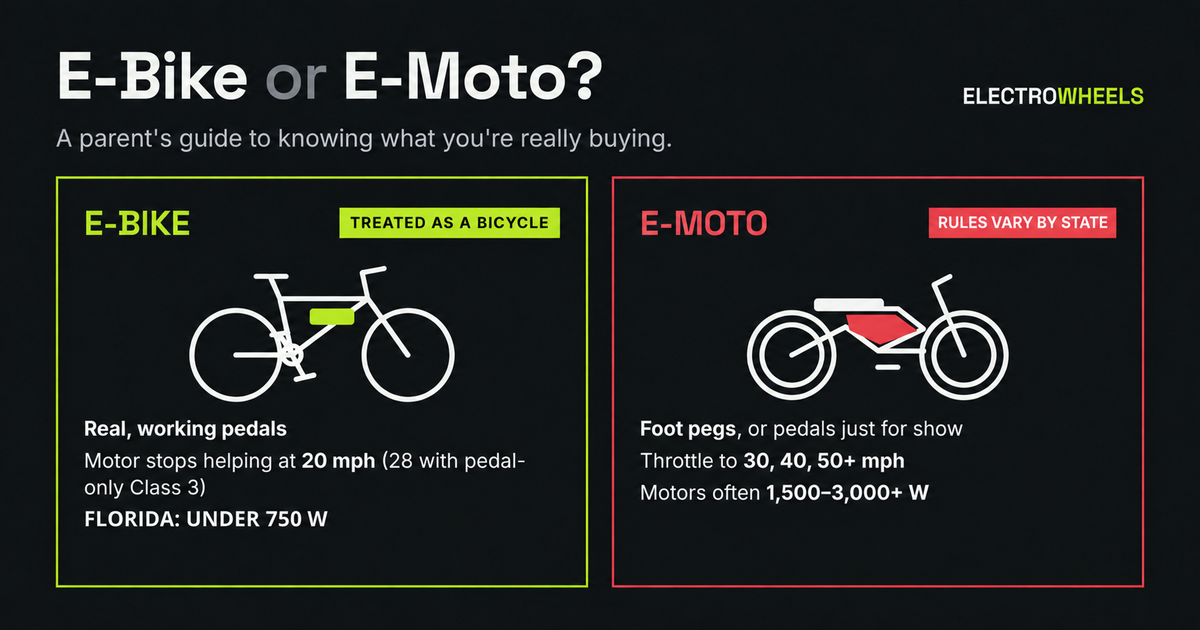
Most states, including Oregon and Florida, use the same three-class system. A true e-bike has working pedals, a seat, and a motor that stops helping at a set speed:
| Class | How the motor works | Motor stops helping at |
|---|---|---|
| Class 1 | Only while you pedal | 20 mph |
| Class 2 | Throttle or pedal | 20 mph |
| Class 3 | Only while you pedal | 28 mph |
Florida requires e-bike motors to be less than 750 watts (Florida statute) (Florida e-bike guide, FDOT). State requirements vary.
Notice what's not on that chart: a throttle that pushes past 20 mph. And nothing that goes past 28 mph on motor power. The cutoff applies to motor assistance; an e-bike may coast faster.
What makes it an e-moto
If the motor can push the bike past those limits, it falls outside the e-bike classes. Whether it is a motor vehicle, and where it can be used, depend on the vehicle and the jurisdiction. Warning signs:
- A throttle that keeps pulling past 20 mph
- Top speeds of 30, 40 or 50+ mph in the listing
- Motors rated well over 750 watts, often 1,500 to 3,000+
- Foot pegs instead of real pedals, or pedals that are clearly decoration
- An "off-road mode" or "unlock" code that removes the speed limit
That last one matters. People for Bikes, the bicycle industry's national trade group, distinguishes e-bikes from e-motos (PeopleForBikes). A "Class 2 mode" alone doesn't guarantee legal status on the street.
Why it matters for your kid
An e-bike is treated like a bicycle. An e-moto generally isn't. Depending on your state, that can mean it needs a license, registration and insurance, and it may not be allowed in bike lanes, on paths, or on public roads at all. If your teen gets stopped or crashes on one, you may be the one answering for it.
And the physics don't care about the label. A 13-year-old at 35 mph in a bike lane is a different risk than the same kid at 15.
The age rules: Oregon
As of November 24, 2026, Oregon generally requires e-bike operators to be at least 16. That changes on January 1, 2027, under House Bill 4007: operators must be at least 14 for a Class 1 e-bike and at least 16 for Class 2 and Class 3, except that younger riders may operate Class 1 or Class 2 while participating in a qualifying bicycle safety program. On highways and premises open to the public, riders and passengers under 16 must wear a helmet, subject to a religious exemption. Starting January 1, 2027, the same law bars sellers from advertising or selling a vehicle as an e-bike if it doesn’t meet the state’s legal definition.
In plain terms: through December 31, 2026, Oregon generally requires e-bike operators to be at least 16. Starting January 1, 2027, a 14-year-old can ride a pedal-assist Class 1 e-bike. They can ride a Class 2 throttle e-bike only while participating in a qualifying bicycle safety program; otherwise they must be 16. Class 3 requires the rider to be at least 16. An e-moto that doesn’t meet Oregon’s e-bike definition is not legally an e-bike, regardless of the rider’s age.
The age rules: Florida
Florida has no statewide minimum age for e-bikes. Riders and passengers under 16 must wear a helmet (FDOT). Since July 1, 2025, cities and counties can set their own minimum age and photo ID rules (FDOT), and some have. Check your city's rules.
The e-moto line still applies in Florida. A bike that goes beyond the e-bike classes isn't covered by the e-bike rules, and it can trigger licensing and registration requirements.
The 60-second parent checklist
Before you buy, look for:
- A class label (1, 2 or 3) on the frame or in the listing. No class? Ask why.
- Motor wattage. Florida requires less than 750 W. State requirements vary.
- Top motor-assisted speed. 20 mph (Class 1 and 2) or 28 mph (Class 3, pedal only). Higher motor-assisted speeds fall outside these classes; check state and local rules.
- Real, working pedals.
- No "unlock" or "off-road" speed mode. If it can be unlocked, assume your kid will find out how.
- Your state's and city's age rules for that class.
Our take
We love seeing more people on electric bikes. That's why we build them. But calling an e-moto an e-bike puts kids at risk and gets real e-bikes banned from the paths everyone shares.
Looks like a moped. The Sprinter has a moped look and the Python looks like a street bike. All ElectroWheels e-bike models are Class 2; rider-age and local riding rules still apply.
Buy the right machine for the right rider. And if you're not sure what you're looking at, ask us. We'll tell you straight, even if it's not ours.
Questions about a bike your family is considering? Call 321-379-0613 or book a ride on our homepage. No sales pitch, just the facts.
This article is general information, not legal advice. E-bike laws change often and vary by city. Check your state and local rules before you buy or ride.